Wednesday, July 6, 2011

History Of Buddhist Saturday & Sunday School


Buddhist School of either Saturday or Sunday School are processing in various Buddhist countries such as Sri Lanka, Burma, Thailand..etc. This method copied from the Buddhist monk missionary in various European countries that those monk missionaries faced with problems that those people and children are always too busy with their study and works beside of Saturday and Sunday. Now, the Westerns are more interesting in Buddhism and devout themselves as the Buddhists more and more, all these because Buddhism is so challenging with their wisdom, intelligence and modern world.
Follow statistic of Buddhists population only in USA there were 30,000 Buddhists in 1900--- the number of people practicing it sharply rose in the past two decades. There were 200,000 Buddhist in the United States in the mid-70s. The number swelled to 1.8 million by 1995, according to the Encyclopedia Britannica.
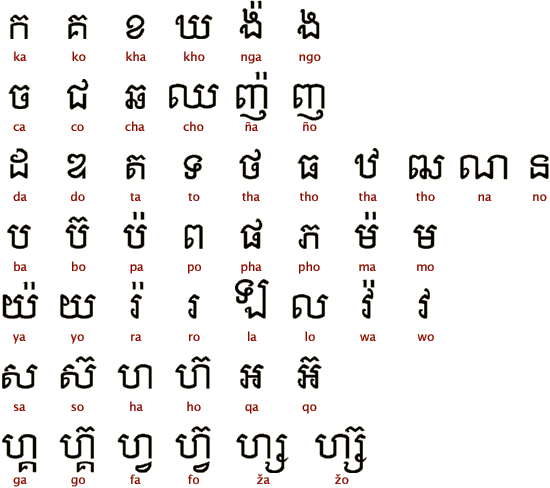
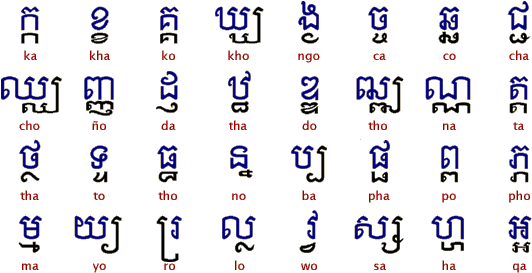
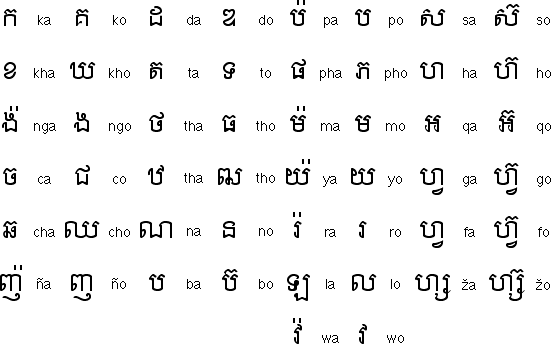
Khmer Consonants


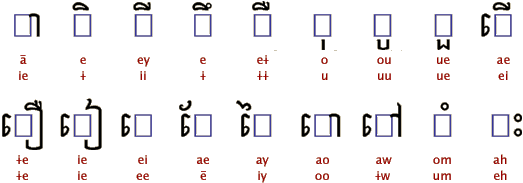
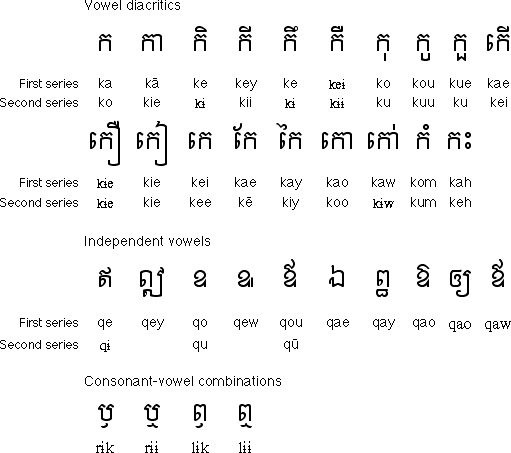
Khmer Vowels

Other Vowels


Khmer Consonants by Grouping
Khmer Vowels by Pronouncing

Khmer Numbers

Labels:

Historical Linguistics

What ancient scripts ultimately capture is part or whole of a tongue spoken in antiquity. However, as you may have noticed, all human languages evolve over time. For instance, English poems written in Shakespeare's time don't rhyme correctly anymore, but a look at their archaic spelling indicates that they should rhyme.
As changes accrue over time, ancient texts become unintelligible if the knowledge of the language is lost. In some cases, the texts can be read, but cannot be understood. The best example of this is Etruscan, which is written in a script nearly identical to the Roman alphabet, so individual sounds and words can be isolated. However, since nobody knows what the words' meanings and the grammatical rules of Etruscan, the texts remain relatively obscure.
Alas, not all is lost. If ancient language had survived and evolved into later, "daughter", languages that can be understood, then it becomes possible to know something the "parent" language as well as the processes involved in the evolution. This study of language change through time is called historical linguistics.

Labels:

Phonetics Sounds

As you know, the English alphabet is far from being a regular and consistent system of representing all the sounds in English. For instance, think of the letter group ough. How many different way can it sound like:

Word Rhymes with..
(in Standard American Dialect)
through true
though go
cough off
thought not
tough stuff
And as you can see, "ough" can produce a myriad of sounds seemingly randomly. In addition, these endings may rhyme different in other dialects of English as well. Therefore linguists cannot rely on such whimsical system to scientifically represent sounds in a language. The solution was the creation of symbols explicitly designed to represent all sounds that humans can produce. We call such systems "Phonetic Alphabets".
Unfortunately concensus is the last thing linguists have between them and consequently several systems exist. The most famous one is the International Phonetic Alphabet or IPA, but the American Phonetic Alphabet is also quite widespread. I have chosen to adhere to the American system in this page because that's what I've been taught in. If you are familiar with the IPA there shouldn't really be any problems once you understand corresponding equivalent symbols in the two systems.
The following are some of the signs of the American phonetic system. When used for transcription, sounds are put inside square brackets, ie [ ]. Related and similar sounds in a language often occur in complementary distribution, that is, each of these sounds appear only in unique situations. For example, in English, the "t" in "top" sounds different from that in "stop". However, the "t"-sound in "stop" (which is less powerful the the "t" in the beginning of a word) only occurs after a "s" sound, while the "t" in "top" occurs everywhere else, and therefore these two sounds are in complementary distribution. We call this set of sounds a phoneme, and write it between two slashes, ie / /.
Formally, /t/ becomes [t] after [s], and becomes [th] everywhere else. The superscript h means that the consonant before it is produced with a little more air.
Consonants:

Some important points:
Vowels:

Even though they look like English, don't be tempted to pronounce the symbols as if they were English letters. For instance, the symbol [i] really sounds like the 'ee' in "reed". The symbol [e] doesn't sound like the 'e' in 'be', but more like French 'être'.
When you say a vowel, you unconsciously change your tongue and lip into an unique configuration characterized by three attributes:
Tones
In many languages of the world, tone plays an important role in distinguishing one morpheme from another.
Notice that tone isn't the same as stress or intonation. All of these involve changes in the pitch of the voice. Stress, sometimes also known as accent, is the rise and fall of the pitch throughout the syllables of a word. In English, there is usally a highest stress in a word, like "kéyboard" or "exáct", but also in some cases two stresses, one higher than the other, occur, like "singularity". Intonation is the rise and fall of the pitch throughout the words of a sentence. Notice how the statement "You are sick" sounds different from the question "You are sick?" In the statement, the words have more or less even pitches with respect to each other. On the other hand, the question's pitch peaks at the adjective "sick". Both contrasts with an interjection like "You are sick!", which places highest pitches on "You" and "sick".
Tone is somewhat like stress in that it also is the rise and fall of the pitch throughout a word. However, tone is used to distinguish words that have the same sounds which may have unrelated meanings, while stress is not. (Actually, in a few cases, stress does serve to distinguish different meanings or version of the same word, but never consistently as tone.)
Furthermore, the beginning pitch and the ending pitch of a tone is central to distinguishing words. Slightly different beginning or ending pitch means different words. On the other hand, the highest point in a stress can be any degree of pitch above the unstressed syllables. The difference doesn't matter as long as the stress rises above the other syllables.
There are several ways of representing tones in Romanization. Pinyin (for transcribing Mandarin) and Vietnamese uses diacritics. Some phonetic transcriptions use single digit numbers. So 1 in Cantonese is the high falling tone, 2 is the low falling tone, and so on. Neither system directly indicates the tone.
There are two other systems that do directly illustrate the tonal change. One uses a vertical bar to denote a scale, and horizontal or diagonal lines to represent the change in pitch.
The best system that I have seen is a two digit number, ranging from 1 to 5. The first (leftmost) digit is the starting pitch, and the second (rightmost) digit is the ending pitch. Together, it tells you which pitch to start and which to end.
Since I am a native speaker of Cantonese, I'll use its tonal system for demonstration. In traditional Cantonese, there are 9 basic tones, but in my dialect (Hong Kong) the high rising and low rising tones have become indistinguishable. Also, the high falling tone has become very similar to the high-level tone (which doesn't technically exist in Cantonese but can be found in Mandarin). I will try to reproduce all the distinguishing details in these tones, but don't take my pronunciation as canonical. The rest are relatively close to reality.
Description Example Sounds
High falling  [ma53] "mother" AU | WAV
Low falling[ma31] "sesame; hemp" AU | WAV
High rising[ma35] ??? AU | WAV
Low rising[ma13] "horse" AU | WAV
Mid level[ma33] "question marker" AU | WAV
Low level[ma11] "to scold" AU | WAV
High short[pok55] "to hit" (quite onomatopeic) AU | WAV
Mid short[pok44] "to struggle (restlessly)" AU | WAV
Low short[pok22] "thin" AU | WAV

Labels:

Khmer

The Khmer script was one of the earliest writing systems used in Southeast Asia, first appearing in the 7th century CE. It derived immediately from the Pallava script, a variety of the Grantha script of South India, which in turn ultimately is descended from the ancient Brahmi script of India.
Like all Brahmi-derived scripts, Khmer has certain traits similar to those found in South Asian scripts. The direction of writing in Khmer is left to right, and downwards when horizontal space runs out. Khmer is a syllabic alphabet, meaning that a letter represents a syllable in the form of a consonant followed by an inherent vowel. An interesting feature of the Khmer script is that there are two letters for each consonant, one letter carrying the inherent vowel of /a/ and the other /o/. This stems from reusing letters for sounds present in Indian languages but not Khmer. So, roughly speaking, the a-letters correspond to the voiceless letters in Indian scripts, and o-letters to the Indian letters for voiced consonants (fewer of which exist in Khmer than in Indian tongues).
The following is the Khmer script. Note that q is the stands for the glottal stop. Another note is that the last row of letters (g-, f-, and zh-) represent sounds found only in words borrowed from other languages.
Note that I have rearranged the alphabet to group letters by their initial consonants, thus scrambling the traditional alphabetical order. The normal ordering of letters follows those in Indic scripts, but translated onto the a and o letters of Khmer. So for example, the velar (/k/-like sounds) letters in Indic scripts are ordered as ka, kha, ga, gha, and nga. As previously mentioned, voiced consonants letters in Indic scripts were reused for the o-series of letters, and therefore this transforms into ka, kha, ko, kho, and ngo.
Another feature of the Khmer script is the use of extra strokes (called vowel diacritics) around a letter to change the inherent vowel. Once again, because there are two letters for each consonant, the same vowel diacritic works differently for an a-letter and an o-letter. The following chart illustrates this dichotomy. The first line under each row of vowel diacritic lists the vowels for the a-letters, and the second line lists the vowels for the o-letters.
But of course, there are exceptions. The q- letters don't use vowel diacritics, but instead have special letters for many of the vowels. This stems from the fact that the q- letters came from the word-initial /a/ vowel letter in Indic scripts. As there were letters for other word-initial vowels in Indic scripts as well, they also were incorporated into Khmer as q- letters. All q- letters only appear at the beginning of a word, which is the only place where a glottal stop can occur in Khmer.
In addition, certain syllables starting with /r/ and /l/ are also written using special letters too. Once again, this stems from Indic scripts having special cases with /r/ and /l/ sounds.
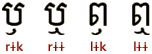
Consonant clusters are written using ligatures. A ligature is a "double decker" sign composed of a normal letter and a subscript. Normally, subscripts are smaller versions of the normal letters, but sometimes they are mutated into shapes that don't resemble the corresponding normal letters. In a cluster, the first letter to be read is the normal letter, which sits at the "central" location, and the second letter is the subscript, which sits under the first letter and sometimes extends up the side of the first letter. The following chart lists normal letters (in blue) and respective subscripts (in black).
The following is an example of subscripts used in conjunction with normal letters and vowel diacritics to write out Khmer words.
The Khmer script is still used in Cambodia, having evolved over more than a thousand years. One consequence of this long history is that certain words are not pronounced as they are spelled, so sometimes a comma-like diacritic is placed on letters that are no longer pronounced.
The Lao and Thai scripts are related to the Khmer script, but exact relationships are unknown. Some consider Lao to be a "sibling" to Khmer and Thai as a derived script, but with the rapid spread of Buddhism and Indian scripts into Southeast Asia the exact parentage of these scripts will likely remain uncertain.

Labels: